Sunday, July 15, 2012
Computer Literacy Centre for Students in Bo
 It has been a long road but our computer learning center in Bo now seems successful and sustainable with 8 machines up and running. Importantly there is a steady flow of eager students from local secondary schools and from the local Njala University. Cost for each student is about 20c per hour. The effort to get this going in the right way was enormous, a much greater challenge than I was expecting. There are many to thank and I’ll mention them later.
The context is that in the City of Bo and in the surrounding District of Bo there are few opportunities for students to learn how to use a computer. The population totals roughly 500,000 and the average age is reportedly about 17 so there are a significant number of students. All secondary school students learn in  theory from a traditional chalkboard or blackboard where the teacher draws an image and tries to convey how the computer works. Obviously this is very frustrating for the students but there seems to be a complete lack of any computer hardware or software resources. Even the teachers lack practical training and seem to work solely from texts.
  The local Njala University has one computer room located on one it’s two campuses and with a number of ancient desktop machines. However opening times and poor availability of power means that university students lack access.
 theory from a traditional chalkboard or blackboard where the teacher draws an image and tries to convey how the computer works. Obviously this is very frustrating for the students but there seems to be a complete lack of any computer hardware or software resources. Even the teachers lack practical training and seem to work solely from texts.
  The local Njala University has one computer room located on one it’s two campuses and with a number of ancient desktop machines. However opening times and poor availability of power means that university students lack access.
  Clearly there are many students who perceive a need to become computer literate. Entrepreneurial business people have attempted to respond with some fledgling resources.
  However the schools have a limited number of instructors, the courses are very expensive, there are relatively few computers and there is a lack of consistent power. Internet cafes are very expensive where an hourly charge of about $2 is an average daily wage and out of reach of most students. Moreover the internet cafes lack learning programs and do not offer instructional service.
  They both appreciated the idea and were prepared to offer a secure room on the main floor and without any rental charges. A previous attempt at a learning center involving Kama Printing failed since Kama moved and lacked the space at the new location.
 These were shipped to Freetown where the valuable cargo was the subject of some “shrinkage” and the remainder required some cash before they could be released. However the process would not have been possible without the efforts of Altus’s Bob Van der Linde and VSO “superman” Bernard N’Gaiwa. Overall we were left with a total of 8 working laptop computers.
 An excellent basic computer skills course was obtained from a VSO medical advisor who previously worked for the National Health Service – highly recommended and the schools most popular course.
 Someone to manage and run the center was a significant role to fill and both Sunil and I interviewed candidates requiring both marketing, business and some basic computer skill. Mohamed Bah was selected and is now assisted by Francis Lahai. They were both given basic training in bookkeeping, care of computers and marketing.
  Their compensation is linked directly to the amount collected less the costs of fuel and maintenance of the standby generator. Overall management responsibility is taken by the two local Municipal Councils operating in the area and they were incentivized by providing a service to their constituents at a limited cost.
  Both Councils were also attempting to persuade people to pay a new property tax and the computer school amenity provided a service to offer. Bo District Council Deputy Chairman Joseph Bindi, and Bo City Chief Administrator William Alpha are now strong supporters and have taken ownership of the Center. The key objectives and responsibilities are set out at the bottom of this article
There are many to thank and a few are as follows
• Joseph Bindi, Deputy Chairman of Bo District Council
• Mayor Wusu Sannoh of Bo City Council
• William Alpha, Chief Administrator of Bo City Council
• Altus Group – Mitchell Smith who provided technical help and Bob Van der Linde who helped with the shipping process.


Student Computer Learning Centre
Objective
• The centre is to be available for students in Bo District and Bo City so that they can learn common software and essential computer skills.
• The centre is to be stocked with computers loaded with appropriate self teaching software
• The centre is to have the use of a generator
• The centre is to operate on a non-profit basis
• A modest affordable charge is to be made for the use of the computers
Operating Committee
• The Operating Committee is to appoint, dismiss and direct the manager
• The Operating Committee is to comprise Alfred Maada Fobay from OWL, Joseph Bindi from Bo District Council, William Alpha from Bo City Council and Augustine Robinson at Rada
• The Operating Committee is to meet as needed or at the request of the Manager
Manager Responsibilities
• To maintain opening hours for students initially from 4pm to 9pm Monday to Friday and Saturday, 10am to 1pm
• To keep the room clean and to dust each computer, leaving the laptops closed while not in use.
• To keep all equipment secure including computers and generator
• To maintain a daily log book of each student visit with hours, charges paid and type of software used together with student name, address, school or institution and phone contact.
• To charge students the modest fee agreed by the Operating Committee initially at Le1,500 per student per hour
• To permit student use of memory sticks after scanning them of viruses
• To update virus protection on a regular basis
• To maintain and fuel the generator
• To maintain a daily cash journal showing income and expenses
• To earn a monthly incentive being all cash earned by the Centre during the previous month less the expenses.
• Report to the Operating Committee at least once per month on the operations, the bookkeeping and any recommendations.
• Report technical problems to Rada.
• Visit schools and Universities to promote the use of the Centre
• Provide marketing suggestions to the Operating Committee
• Agree charges with the Operating Committee


Saturday, December 04, 2010
Freetown again

I am in Freetown to start another 6 months, this time on a slightly different tack based again in Bo but working not for local councils but for a German NGO Welthungerhilfe.
The task follows on from the Binkolo Growth Centre food processing (see a previous blog) and I am to work with entrepreneurs in the agricultural sector to improve business planning, financial management and marketing – how to make a profit and measure it. The nascent businesses are in honey production, cassava processing as well as coffee, cocoa and other products. I’ll also maintain the work with the local Councils Bo and Makeni sustaining local revenues. Quite a different task from the usual and certainly quite a contrast to property valuation work in Toronto. That’s what gets me going.
I knew I had arrived in Freetown when I took my first poda poda ride,

together with 20 other passengers all seated on metal benches fitted into the beat up Mazda van and with a slightly exposed and worn interior. Cost is still 25c for a ride anywhere along the route. Beats the Toronto Transit Commission.
I was however shocked when on an early Sunday morning walk I saw the state of the main street in the western part of Freetown. Wilkinson Road from Lumley all the way through to the bridge has been bulldozed to make way for a widened street to 4 lanes. For those that don’t know, the 

 traffic during the day is ridiculously
  horrendous such that taxis wont even offer rides unless there is a big price incentive.
China is becoming a big influence on the landscape with strong intentions in the mining of iron ore and other minerals. The Chinese army are undertaking the road construction (the obvious inference is to get better access to the minerals). The Chinese efficiency is incredible. The hugely dense cram of buildings along 5.4 kms of Wilkinson Road has been flattened and in many cases only parts of buildings remain.

In Canada or UK, expropriation or compulsory purchase laws would have taken decades to sort out. Here it’s the “ask questions later” approach. The work is only 5 weeks in the making.
Even on an early Sunday morning ( I couldn’t sleep for the blaring at Paddy’s) the work on the street was going on with the Chinese

 obviously directing but road work employment given to locals – and working at a furious rate, something rather unusual for Sierra Leoneans.
 I need to find the secret motivation.
One of the by products of the destruction is the availability of masonry that can be collected and used. This father and his children were building the family a new home.
 Others were collecting water from the burst main supply along the road and that would otherwise be difficult and expensive to get.

Those that know Wilkinson Road can see that Montana’s restaurant has been sawn in half. Other buildings have been indiscriminately razed or partly razed. Trees are simply pushed aside. Businesses however continue to operate as best they can and in the stoic way only Sierra Leoneans can do.


Sunday afternoon I said goodbye to Joseph at the VSO office and I was collected by my new employer Welthugerhilfe a large German NGO. More about my placement later. My transport to Bo was a typical NGO vehicle, a white landcruiser the stuff of my previous blog articles decrying their use. I felt really awkward at this luxury but I put up with the air conditioning for just a little while.


 traffic during the day is ridiculously
  horrendous such that taxis wont even offer rides unless there is a big price incentive.
China is becoming a big influence on the landscape with strong intentions in the mining of iron ore and other minerals. The Chinese army are undertaking the road construction (the obvious inference is to get better access to the minerals). The Chinese efficiency is incredible. The hugely dense cram of buildings along 5.4 kms of Wilkinson Road has been flattened and in many cases only parts of buildings remain.


In Canada or UK, expropriation or compulsory purchase laws would have taken decades to sort out. Here it’s the “ask questions later” approach. The work is only 5 weeks in the making.
Even on an early Sunday morning ( I couldn’t sleep for the blaring at Paddy’s) the work on the street was going on with the Chinese


 obviously directing but road work employment given to locals – and working at a furious rate, something rather unusual for Sierra Leoneans.
 I need to find the secret motivation.
One of the by products of the destruction is the availability of masonry that can be collected and used.
 This father and his children were building the family a new home.
 Others were collecting water from the burst main supply along the road and that would otherwise be difficult and expensive to get.
Those that know Wilkinson Road can see that Montana’s restaurant has been sawn in half.
 Other buildings have been indiscriminately razed or partly razed. Trees are simply pushed aside. Businesses however continue to operate as best they can and in the stoic way only Sierra Leoneans can do.


Sunday afternoon I said goodbye to Joseph at the VSO office and I was collected by my new employer Welthugerhilfe a large German NGO. More about my placement later. My transport to Bo was a typical NGO vehicle, a white landcruiser the stuff of my previous blog articles decrying their use. I felt really awkward at this luxury but I put up with the air conditioning for just a little while.


Wednesday, June 23, 2010
Computing Update
Computing and computing knowledge is an enormous advantage for Sierra 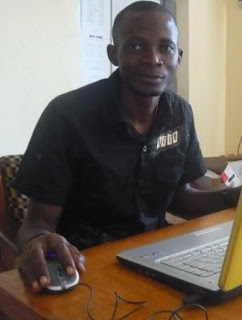 Leoneans and the younger people in particular are acutely aware. Sheka shown here is under my training at the City of Bo. Knowledge and the need to get ahead of peers in the high stakes job market is extremely important. Many of the best opportunities for work are with the government and importantly international non-governmental organizations. Otherwise jobs are scarce and limited to labouring, farming and market selling. A primary requirement is to have computing knowledge and the challenge in acquiring the knowledge is a) access to hardware and software, b) hydro to power the computers c) teaching d) money to afford a, b and c.
In Bo a city of 150,000 people and the largest outside of Freetown the education system is poor and does not have access to any computing. There are several private schools that offer courses but have limited access to very old machines and limited numbers of good instructors.
Altus Group headquartered in Toronto has a program of renewal and updating and as part of the program the company generously sent me 5 laptop machines. The machines were cleaned and software loaded by Altus in-house technician Mitchel Smith before they were shipped. Thanks go to Altus and Mitchel.
Two of the machines were placed in a local printing shop whose owner Joseph Kamara agreed to be a host without charge.
  Joseph is a local entrepreneur who sees an opportunity to earn future revenue from a more knowledgeable local youth.
  He has already opened an internet café next door to the printing shop.
  The printing shop is ideal because it has a reasonably reliable source of electricity driven by a back up diesel generator.
  The power supply is needed for the printing machines and is available to power the computers as well. Software was installed to self teach all of the Microsoft features and programs such as Word and Excel. The computers are made available to students at a cost of 1,000 Leones (30c) per hour and reports from Sheka Kamara who monitors the program, the students, find the availability of machines and the teaching aids very useful
One of the remaining lap tops was placed with the Mayor Wusu Sannoh of the City of Bo. The Mayor is a former academic, a professor of chemistry at Fourah Bay University in Freetown. He was delighted since he had had an old machine that had failed. Another laptop went to the local Njala
 university and specifically to the campus where nursing is taught.
 The last computer was given to a local individual Ramiatu Abu Mussah who was entered into a draw for those who had paid their local City of Bo property tax. The City of Bo had run an incentive program to entice people to start paying property tax and this has now proved to be most successful.
 Leoneans and the younger people in particular are acutely aware. Sheka shown here is under my training at the City of Bo. Knowledge and the need to get ahead of peers in the high stakes job market is extremely important. Many of the best opportunities for work are with the government and importantly international non-governmental organizations. Otherwise jobs are scarce and limited to labouring, farming and market selling. A primary requirement is to have computing knowledge and the challenge in acquiring the knowledge is a) access to hardware and software, b) hydro to power the computers c) teaching d) money to afford a, b and c.
In Bo a city of 150,000 people and the largest outside of Freetown the education system is poor and does not have access to any computing. There are several private schools that offer courses but have limited access to very old machines and limited numbers of good instructors.
Altus Group headquartered in Toronto has a program of renewal and updating and as part of the program the company generously sent me 5 laptop machines. The machines were cleaned and software loaded by Altus in-house technician Mitchel Smith before they were shipped. Thanks go to Altus and Mitchel.
Two of the machines were placed in a local printing shop whose owner
 Joseph Kamara agreed to be a host without charge.
  Joseph is a local entrepreneur who sees an opportunity to earn future revenue from a more knowledgeable local youth.
  He has already opened an internet café next door to the printing shop.
  The printing shop is ideal because it has a reasonably reliable source of electricity driven by a back up diesel generator.
  The power supply is needed for the printing machines and is available to power the computers as well. Software was installed to self teach all of the Microsoft features and programs such as Word and Excel. The computers are made available to students at a cost of 1,000 Leones (30c) per hour and reports from Sheka Kamara who monitors the program, the students, find the availability of machines and the teaching aids very useful
One of the remaining lap tops was placed with the Mayor Wusu Sannoh of the City of Bo.
 The Mayor is a former academic, a professor of chemistry at Fourah Bay University in Freetown. He was delighted since he had had an old machine that had failed. Another laptop went to the local Njala
 university and specifically to the campus where nursing is taught.
 The last computer was given to a local individual Ramiatu Abu Mussah who was entered into a draw for those who had paid their local City of Bo property tax. The City of Bo had run an incentive program to entice people to start paying property tax and this has now proved to be most successful.
 In Makeni a computer school was started by Peter Lansana a graduate of a local college partnered with Adikalie Kamara  my City of Makeni technician and trainee. They are still looking desparately for some laptops since their power supply through back up generators lacks fuel and is eratic.
  The photo shows Adilkalie in training at the local UN office allowing us to use reasonable space and importantly power.
 my City of Makeni technician and trainee. They are still looking desparately for some laptops since their power supply through back up generators lacks fuel and is eratic.
  The photo shows Adilkalie in training at the local UN office allowing us to use reasonable space and importantly power.